
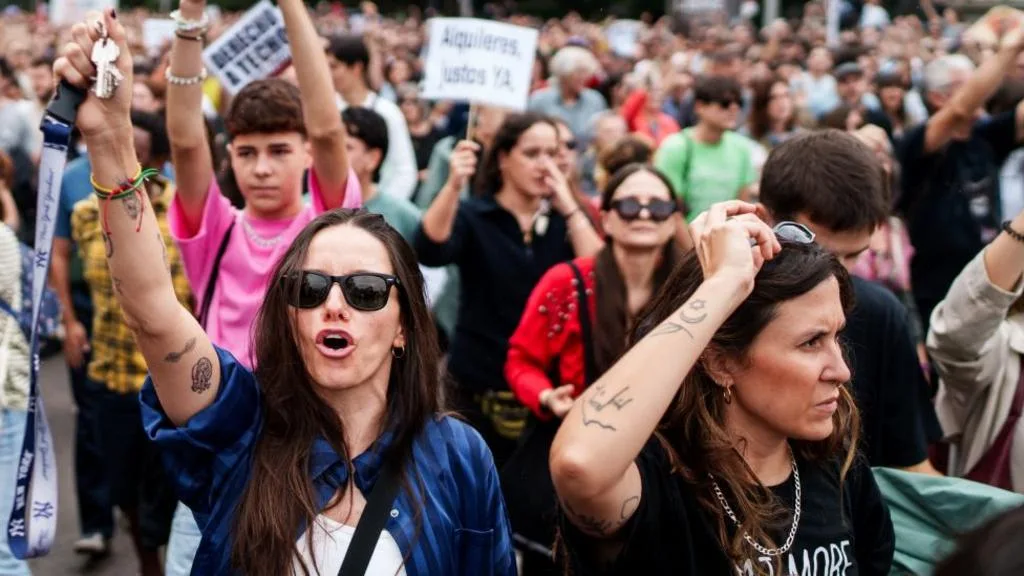
Protests grew after parliament rejected the measures
Spain’s housing crisis was thrust back into the national spotlight after parliament rejected the government’s emergency plan. Following the failure on Friday of Pedro Sánchez’s government to push through two decrees aimed at protecting tenants, around 50 marches were planned on Saturday in cities including Madrid, Valencia and Barcelona.
One of the largest demonstrations took place in the capital, Madrid. Estimates of turnout varied widely: the Madrid Tenants’ Union said 500,000 people attended, while government officials put the figure at 70,000. Some demonstrators had been camping for days in Puerta del Sol square.
Clashes with police in Valencia
In Valencia, the protests gathered near the Palau de les Arts Reina Sofía, which hosted a housing summit. A spokesperson for the Valencia Tenants’ Union said, “There is huge anger in the streets,” as clashes broke out between some protesters and police.
According to Spanish media, some protesters removed barriers and threw objects at police, who responded with rubber bullets. Public broadcaster RTVE said 9 police officers were injured and five people were detained.
What was in the rejected measures?
The first decree voted on in parliament was rejected by 178 votes to 172, while the second was defeated 184 to 166. The minority coalition government needed support from small nationalist parties in Catalonia and the Basque Country after opposition from the People’s Party (PP) and Vox.
However, the pro-Catalan centre-right Together for Catalonia (JxCat) said before the session that it would vote against both measures. The outcome also intensified debate over whether Sánchez may call an early general election.
- The first decree would have suspended evictions of vulnerable tenants until 2030, extended leases set to expire before 2028 by two years and increased taxes on tourist apartments.
- The package also included limits on property purchases by investment funds, while the second decree would have allowed automatic renewal of rental contracts.
Rising rents and a housing shortage deepened the crisis
Eviction case sparked nationwide anger
The protests were triggered by the September eviction of 87-year-old Maricarmen Abascal, who could not afford a steep rent increase. An agreement was later reached with the apartment’s owner, Urbagestión, allowing her to return at a lower rent, but the protests did not subside.
Spain’s central bank estimates that the country has a shortage of 700,000 homes. According to the national statistics office, INE, house prices rose 12.2% year-on-year in the second quarter of 2026. Real estate firm Idealista said rents increased 8.5% in 2025, with Madrid alone seeing a 9.7% rise; Barcelona and Madrid became the country’s most expensive rental markets, at €23.80 and €22.70 per square metre, respectively.
"""





Comments (0)
No comments yet. Be the first to comment.
Write a Comment
Yorum yazmak için giriş yapın. Üyelik ücretsiz; yorumunuz editör onayından sonra yayımlanır.