
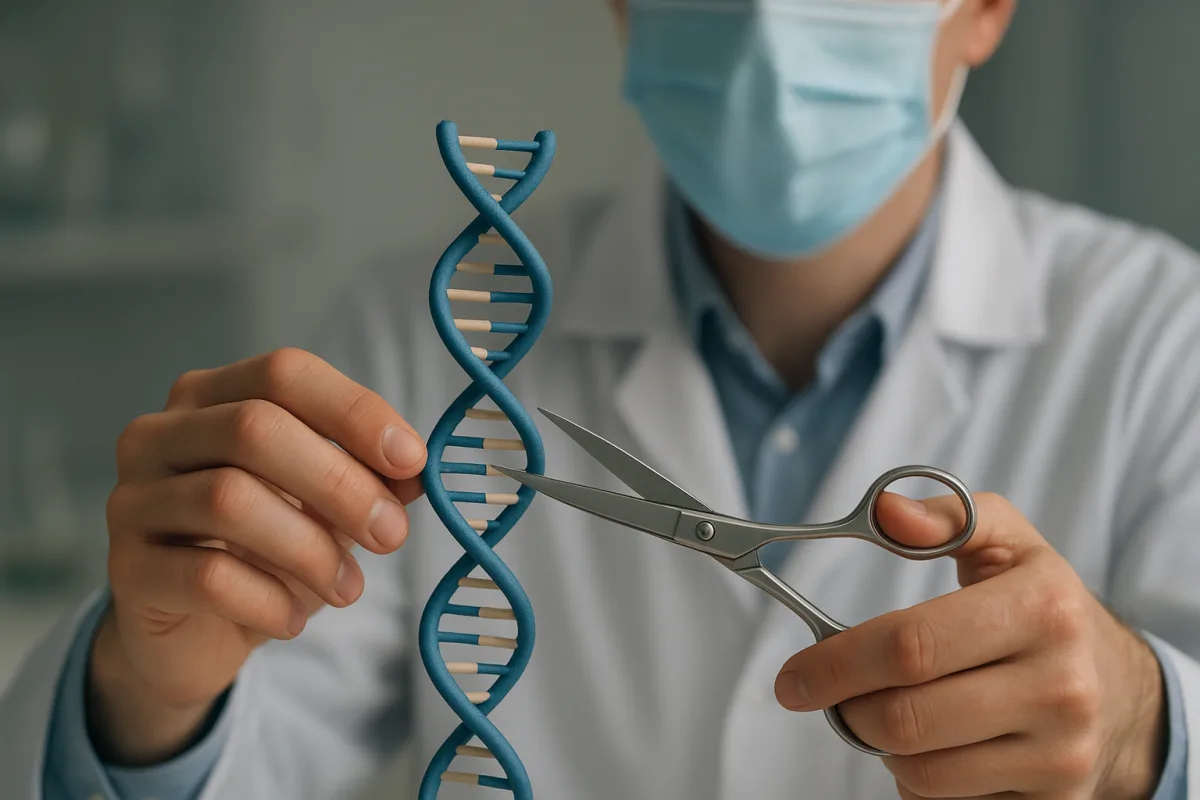
What is CRISPR and how did it enter the scientific world?
The technology known as the CRISPR gene scissors is a gene-editing approach that makes targeted changes to DNA possible. The shortest answer to “what is crispr” is that it is a biological tool adapted from an acquired immune system bacteria evolved to defend against viruses.
CRISPR sequences were first reported in 1987 in Yoshizumi Ishino’s study of E. coli. The name “CRISPR” was given by Spanish microbiologist Francisco Mojica. The technology’s transformation into a programmable laboratory tool accelerated with the 2012 study by Jennifer Doudna and Emmanuelle Charpentier published in Science; the two scientists won the 2020 Nobel Prize in Chemistry for this contribution.
How does Cas9 gene editing work?
How does guide RNA find the target?
Guide RNA identifies the sequence corresponding to the DNA region that is meant to be edited and directs the system to the correct location. For this reason, the specificity of CRISPR-Cas9 depends largely on guide RNA design; if there are regions similar to the target, the risk of unintended cuts must also be assessed.
The Cas9 enzyme and the cell’s repair pathways
In the Cas9 gene editing process, Cas9 is the enzyme that creates a cut at the targeted point in the DNA. The actual outcome is determined by which repair pathway the cell uses after that cut. Fast but more error-prone repair can lead to small insertions or deletions; researchers use template-based repair strategies for more controlled changes.
- Reducing or completely shutting down the effect of a gene
- Trying to correct a faulty genetic sequence
- Changing how cells behave against a specific disease
Use in genetic medicine and ethical limits
Why are somatic and germline editing treated differently?
In the field of genetic medicine, the applications that stand out today are limited to somatic cells. These interventions affect only the person being treated. Germline, or reproductive-line, editing can be passed on to future generations, which is why it raises far sharper ethical, legal, and social debates.
What do the first approvals say?
CRISPR is no longer just a laboratory topic. Casgevy, the world’s first approved CRISPR-based therapy, was approved on 16 November 2023 by the U.K.’s medicines regulator MHRA (Medicines and Healthcare products Regulatory Agency). In the U.S., the FDA (Food and Drug Administration) granted approval on 8 December 2023 for sickle cell anemia. In Europe, the EMA’s CHMP committee issued a positive opinion on 15 December 2023, and the European Commission granted conditional authorization on 13 February 2024 for sickle cell anemia and transfusion-dependent beta thalassemia.
Why is the He Jiankui case considered a red line?
The He Jiankui case, which made headlines in 2018 with the announcement of genome-edited babies, made the gap between scientific capability and ethical limits impossible to ignore. The Chinese scientist was prosecuted in his country over the experiment and sentenced to prison in December 2019. The case made clear why international oversight, transparency, and social consensus are seen as indispensable in interventions with heritable consequences.
Today, the debate is no longer limited to the question of whether it can be done. The real issue for the scientific community is which edits are medically necessary, safe, and socially acceptable.
"""




Comments (0)
No comments yet. Be the first to comment.
Write a Comment
Yorum yazmak için giriş yapın. Üyelik ücretsiz; yorumunuz editör onayından sonra yayımlanır.