
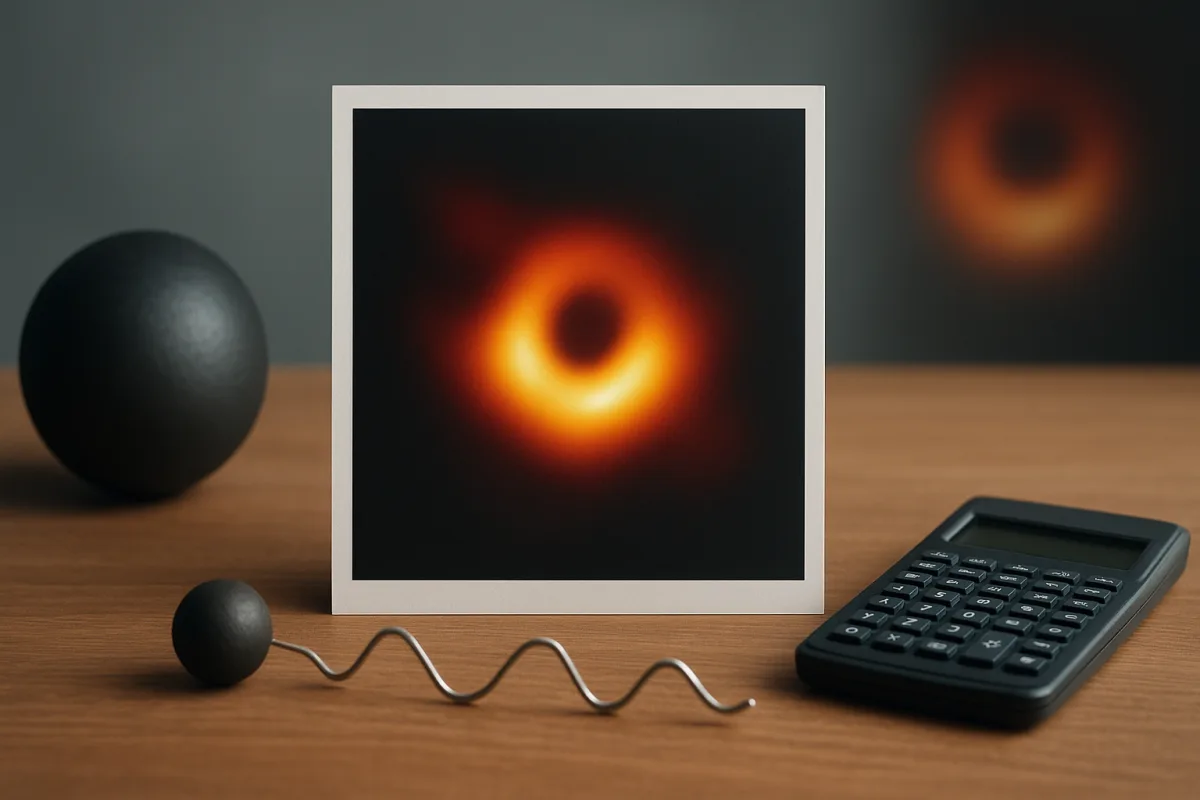
What is a black hole, and why does the event horizon matter?
The shortest answer to what a black hole is is that it is a region where gravity is so strong that nothing can escape easily. But that does not mean black holes are “cosmic vacuums” that randomly suck everything in space toward them. Stars, gas clouds and planets far enough away can remain in orbit, just as they do around other massive objects.
The event horizon is the boundary beyond which there is no return. Even light cannot escape from inside this line, which is the main reason a black hole is “invisible.” In scientific debate, the real issue is not observing the black hole itself, but the matter around the event horizon and its gravitational effects.
- The event horizon is defined as a critical boundary rather than a physical surface.
- Black holes do not instantly swallow everything around them; distance and orbit are decisive.
- Strong gravity can also affect the flow of time.
Images that opened the era of direct observation
How did the Event Horizon Telescope work?
The Event Horizon Telescope made radio telescopes spread across the globe work like one giant telescope by combining them through very long baseline interferometry. This collaboration released the first direct image of a black hole on April 10, 2019. The image showed the M87* black hole at the center of the Messier 87 galaxy, about 55 million light-years away; its mass was announced as about 6.5 billion times the mass of the Sun.
The same network also shared an image of Sagittarius A*, the black hole at the center of the Milky Way, on May 12, 2022. This supermassive black hole, said to have a mass of about 4 million Suns, is much lighter than M87* but far closer to Earth, giving it special importance in black hole research.
Why are they often found at the centers of galaxies?
Current observations show that many large galaxies have supermassive black holes at their centers. As in the Milky Way, the motion of stars orbiting near the center points to the presence of this invisible mass. Roger Penrose, Reinhard Genzel and Andrea Ghez were awarded the 2020 Nobel Prize in Physics for their work in this field.
Gravitational waves, time effects and what remains unconfirmed
How were black hole mergers “heard”?
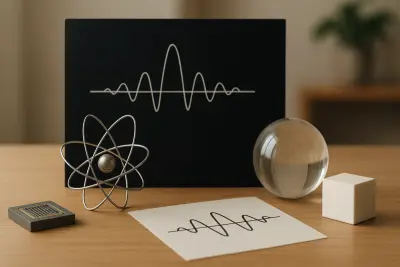
LIGO detectors recorded the first gravitational-wave signal on September 14, 2015; the discovery was announced on February 11, 2016. The signal showed that ripples created in spacetime by merging black holes could be measured. The work paved the way for the 2017 Nobel Prize in Physics for Rainer Weiss, Barry Barish and Kip Thorne.
Does time slow down, and has Hawking radiation been proven?
According to general relativity, time passes more slowly in strong gravitational fields; the region around a black hole is one of the most extreme examples of this. This effect is accepted as one of the core results of modern physics through theoretical work and indirect observations. By contrast, Hawking radiation, proposed by Stephen Hawking in 1974, has not yet been directly confirmed by astronomical observations. In other words, we know a great deal about black holes, but not all questions have been answered.
"""





Comments (0)
No comments yet. Be the first to comment.
Write a Comment
Yorum yazmak için giriş yapın. Üyelik ücretsiz; yorumunuz editör onayından sonra yayımlanır.