
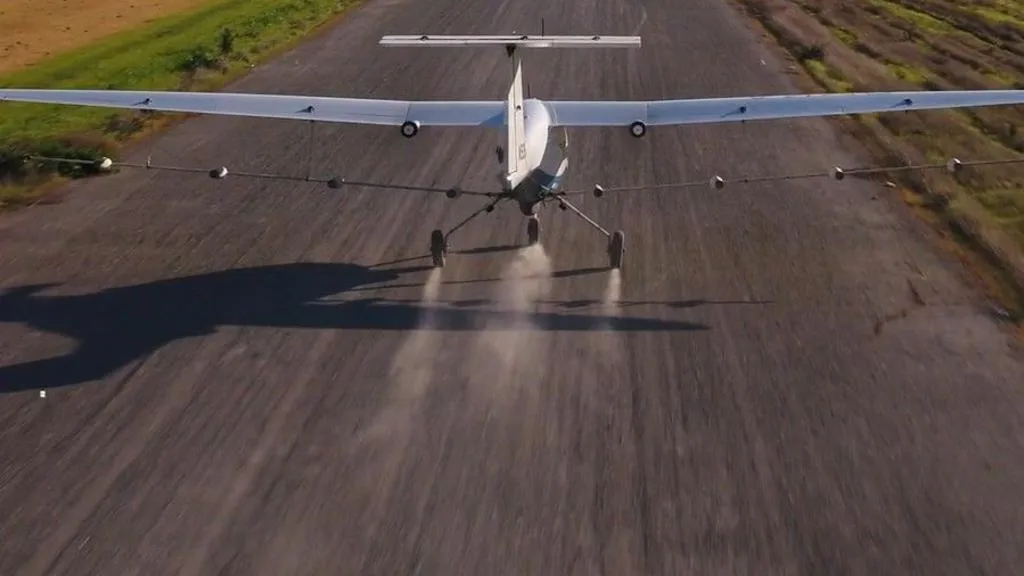
Agricultural spraying became the first commercial use case
Autonomous aircraft developed in the U.S. have started generating revenue first in agricultural spraying and cargo transport. A pilotless plane from Pyka, tested in California’s San Joaquin Valley, can fly lower than crewed crop-dusting aircraft, reducing spray drift and therefore lowering chemical use.
Pyka’s fully electric sprayer can stay aloft for about 35 minutes with a battery in its nose and carry 300 liters of liquid in a tank inside the fuselage. About a dozen of the aircraft, which have a wingspan of roughly 11.5 meters, are now being used in Brazil on crops including cotton and soybeans.
Licenses and production targets are drawing investor interest
The largest autonomous fixed-wing aircraft yet approved in the U.S. for commercial civilian use is Pyka’s agricultural plane. For now, however, operations remain limited to a narrowly defined agricultural use case, with a ground operator and a visual observer required during flights. The company had previously secured similar approval in Brazil as well.
Pyka aims to scale annual output from about two dozen aircraft today to 1,000 by 2030. Each aircraft is priced at around $550,000, and customers also receive operational training, creating a business model that combines hardware sales with service revenue.
Where are companies focusing their commercial bets?
- Cutting chemical use and labor risks in agriculture by reducing spray drift.
- Improving transport efficiency in remote areas by reducing cockpit and pilot workload in cargo operations.
UK-based Windracers is also seeking approval for an autonomous cargo service in Shetland and Orkney. U.S. company Reliable Robotics, backed by Boeing’s venture arm, is testing its system on a Cessna 208B Grand Caravan cargo aircraft, while Merlin Labs is planning a transition from larger military platforms to commercial multi-crew cargo planes. For many companies in the sector, defense contracts provide an important development and financing channel while civilian approvals take much longer.
Safety standards and certification costs are slowing the market
According to experts, commercialization is being held back by the much higher safety bar for aircraft compared with cars. Mykel Kochenderfer of Stanford University notes that certification is more difficult because the consequences of aviation accidents can be severe, which drives up development costs and lengthens time to market.
Companies are also taking very different technology paths. Reliable Robotics is avoiding artificial intelligence and instead relying on rule-based software, radar and a remote-pilot model from the ground, while Merlin Labs plans to use generative AI to interpret air traffic instructions. Pyka, meanwhile, is preparing to add AI-powered cameras to distinguish distant objects alongside a short-range lidar system.
Industry backers point to the potential to ease the pilot shortage, move dangerous tasks away from people and cut costs by allowing one operator to manage multiple aircraft. But the Air Line Pilots Association in the U.S. sees removing the pilot from the cockpit as a serious safety risk. That means the market’s direction will be shaped not only by technology, but also by regulatory approval and safety acceptance.
"""





Comments (0)
No comments yet. Be the first to comment.
Write a Comment