
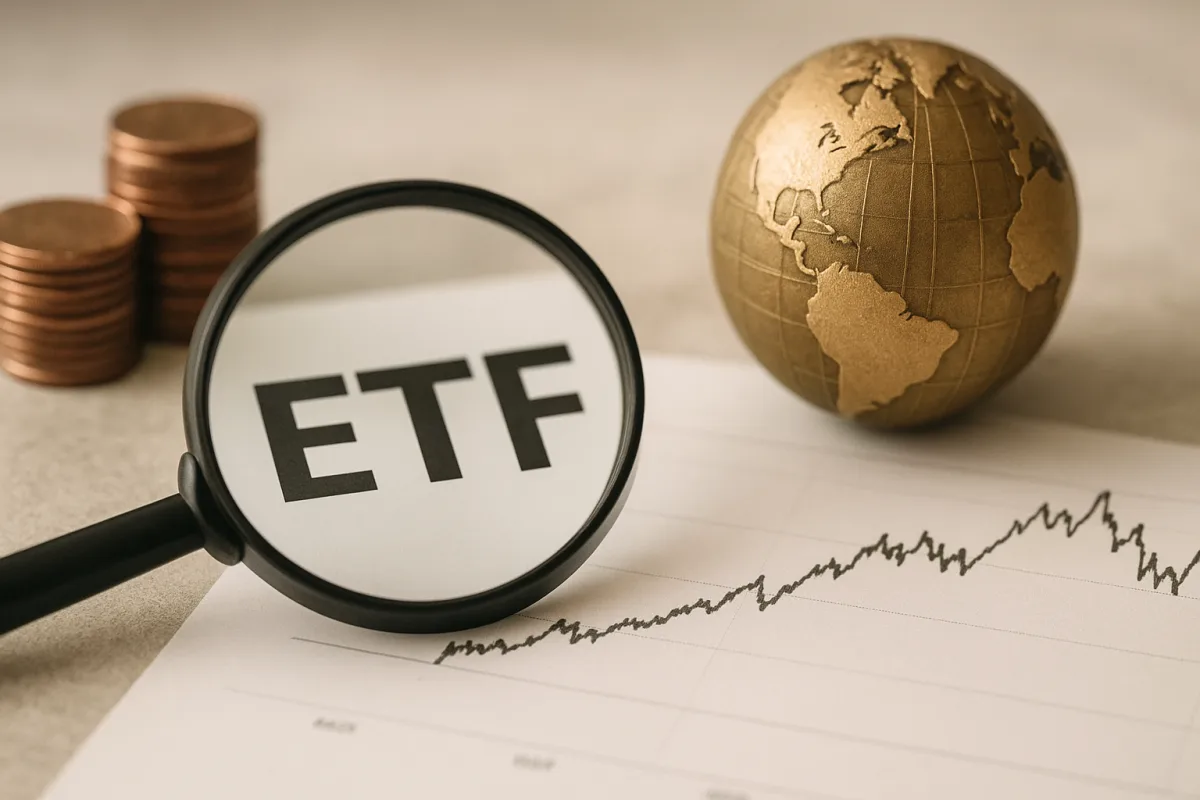
How do ETFs work?
The short answer to what an ETF is is that it is a fund traded on the stock exchange that aims to track a specific basket of assets. Commonly called an exchange-traded fund, it can be bought and sold like a single stock, but behind it lies a basket made up of shares, bonds, commodities or indices.
This structure gives investors the chance to diversify without having to pick individual securities one by one. While an ETF’s price changes throughout the trading session based on supply and demand, the fund’s goal is usually to deliver performance as close as possible to the benchmark it follows.
Basket structure and pricing
ETFs generally track an index, a sector, a country market or a specific theme. Because the price is visible in real time on the exchange screen, investors can decide to buy or sell during the day; in this respect, ETFs offer a more flexible trading experience than traditional funds.
How is it different from a mutual fund?
When people talk about the difference from a mutual fund, the first distinction is trading method and pricing time. In traditional mutual funds, buying and selling often take place based on the net asset value calculated at the end of the day, while ETF prices move throughout the session and orders are placed through the exchange.
- ETFs are traded on the exchange; in traditional funds, the transaction process is usually tied to the fund’s own pricing system.
- ETF prices can change instantly during the day; in traditional funds, the main reference is generally the end-of-day value.
- ETFs may show a bid-ask spread; in traditional funds, the effect of this spread is felt in a different structure.
Why do some investors compare them?
ETFs are especially relevant for investors who follow the market regularly and care about timing their trades. By contrast, for some investors looking for a longer-term and simpler process, traditional mutual funds may be operationally easier to understand. The choice depends less on the product itself and more on the investor’s goals, risk tolerance and trading habits.
What are the risks of ETFs?
ETF risks are not limited to the direction of the market. Even if a fund tracks an index, it can still be affected by a decline in that index; liquidity conditions, trading costs and how closely the fund follows the benchmark can also change the outcome.
Key risks investors watch
- Market risk: If the asset group being tracked loses value, the ETF can also fall.
- Liquidity risk: In products with limited trading volume, buy and sell orders may not be executed at the desired price.
- Tracking error: The fund’s return may not match the index it follows exactly.
- Currency and theme risk: Volatility can increase in ETFs focused on foreign assets or a narrow sector.
For that reason, when looking at an ETF, investors should consider not only past performance but also the nature of the underlying assets, trading volume, cost structure and the fund’s strategy. Before making a decision, reviewing the product documents and comparing the risk profile with your own investment plan provides a more reliable framework.




Comments (0)
No comments yet. Be the first to comment.
Write a Comment
Yorum yazmak için giriş yapın. Üyelik ücretsiz; yorumunuz editör onayından sonra yayımlanır.