
Why does the James Webb Space Telescope observe in infrared?
One of the most striking tools in modern astronomy, the James Webb Space Telescope, or JWST, was designed as a space telescope focused on infrared wavelengths rather than visible light. The main reason is that as the universe expands, light from very distant galaxies shifts to longer wavelengths. This effect, known in science as cosmological redshift, makes infrared crucial for studying the early universe and the very ancient cosmic signals often referred to as the “first light.”
Visible light is often weakened by clouds of gas and dust, while infrared light can pass through these obstacles more effectively. That allows Webb to examine star-forming regions, cold celestial objects and very distant galaxies with greater clarity. In short, the infrared telescope approach helps us see not only farther away, but also farther back in time and deeper into faint cosmic structures.
What technical features set it apart from Hubble?
A joint project of NASA, ESA (European Space Agency) and CSA (Canadian Space Agency), Webb was launched on 25 December 2021 aboard an Ariane 5 rocket from Kourou, French Guiana. Its first full-color science images were released to the public on 12 July 2022. While Hubble mainly operates in visible light and ultraviolet, Webb was optimized from the start for infrared observations.
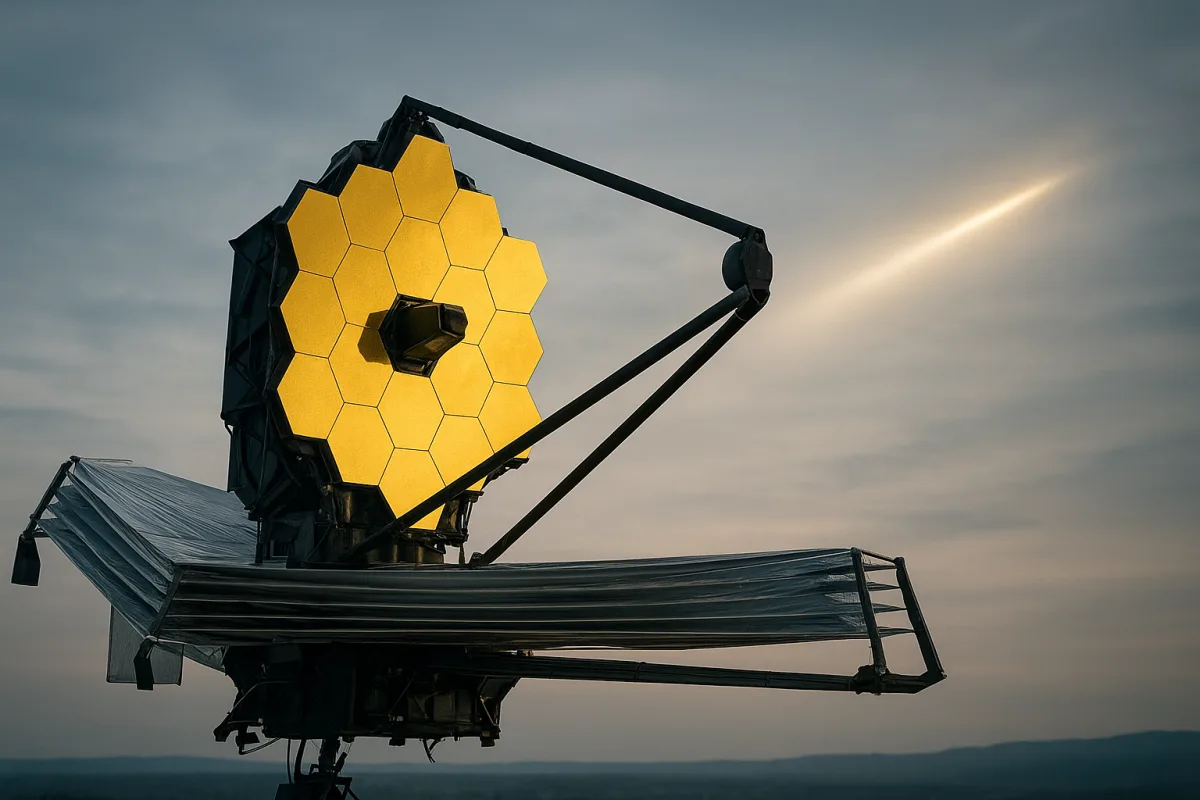
The telescope’s primary mirror is 6.5 meters across and made up of 18 gold-coated beryllium segments. This segmented design made it possible to fit a large mirror inside a rocket and then deploy it in space. The gold coating reflects infrared light efficiently, while beryllium holds its shape at very low temperatures, preserving optical precision.
Why are the L2 point and sunshield so important?
What does the Lagrange point do?
Webb is positioned around the Sun-Earth L2 point, about 1.5 million kilometers from Earth. This region helps keep the Sun, Earth and Moon on the same side of the telescope. That makes it easier to maintain thermal stability and allows the observatory to scan the sky in a steady way.
How does the sunshield cool it?
The five-layer sunshield, about the size of a tennis court, reduces heat from the Sun in stages and keeps the science instruments at around -223 degrees Celsius. That detail is critical, because infrared instruments can detect their own heat as a signal. The better the cooling, the cleaner the faint light from the distant universe can be measured.
What scientific questions is Webb trying to answer?
Webb’s mission is not limited to looking back at the early universe. The telescope is also studying how galaxies formed, under what conditions star and planetary systems develop, and which chemical traces may exist in exoplanet atmospheres.
- Examining the structure of galaxies formed close to the first light of the universe
- Observing dusty star-forming regions in greater detail
- Analyzing traces of water vapor, carbon dioxide and similar molecules in exoplanet atmospheres
In this sense, the James Webb Space Telescope gives scientists a vast research window stretching from the early universe to the search for habitable worlds. What makes Webb special is not just its large mirror, but the way it combines infrared observation, deep cooling and precise positioning in one system to reveal older, fainter and more distant cosmic sources.




Comments (0)
No comments yet. Be the first to comment.
Write a Comment
Yorum yazmak için giriş yapın. Üyelik ücretsiz; yorumunuz editör onayından sonra yayımlanır.