
Why is Göbeklitepe considered a turning point?
Göbeklitepe is seen as one of the most important archaeological sites to challenge the standard narrative about the beginning of the Neolithic age. For a long time, the prevailing view was that complex ritual spaces emerged after farming and permanent settlement had developed; finds in Şanlıurfa suggested that this sequence may not always have been so clear.
The site was first recorded during surface surveys in 1963. But German archaeologist Prof. Dr. Klaus Schmidt realized in 1994 that the stones could date to the Pre-Pottery Neolithic period, and excavations began in 1995 in cooperation with the Şanlıurfa Museum and the German Archaeological Institute. Göbeklitepe was added to UNESCO’s Tentative List of World Heritage Sites in 2011 and to the main World Heritage List in 2018.
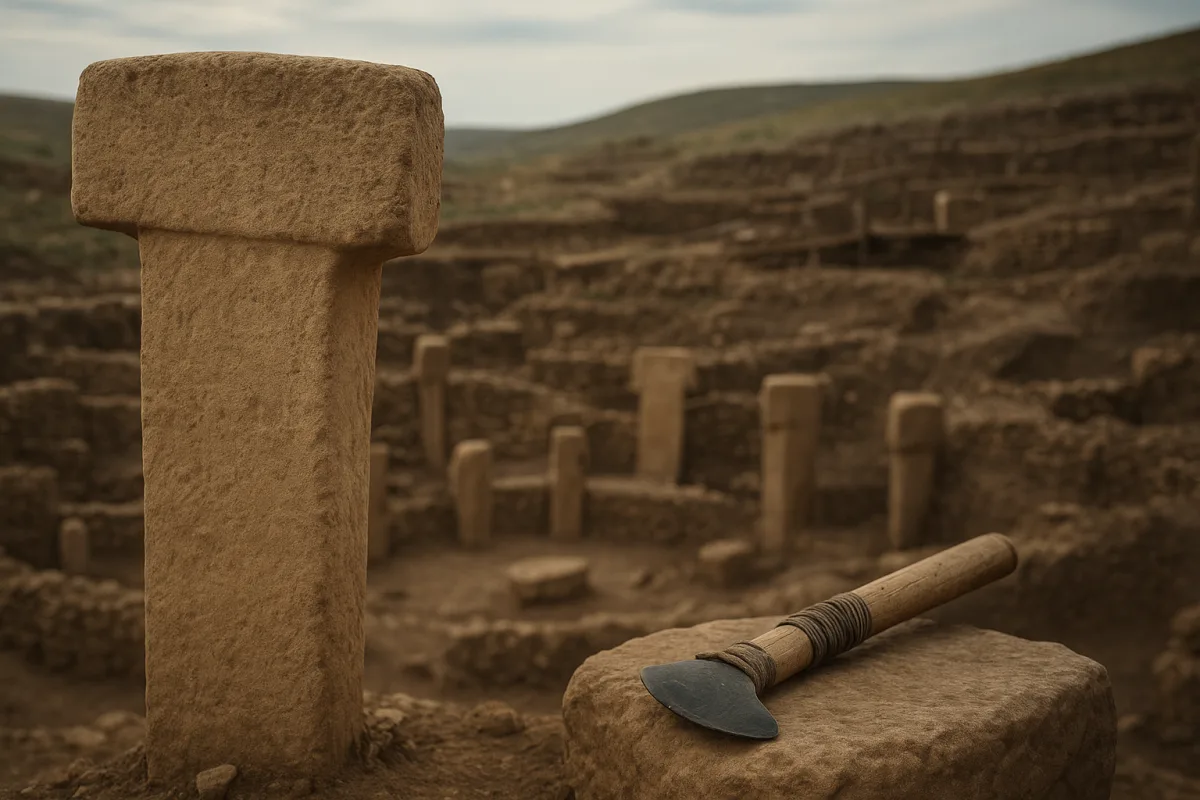
The site’s significance is not only tied to its early date. The T-shaped standing stones, the largest of which rise more than 5 meters and can weigh up to 10 tons, raised new questions about the organizational capacity, division of labor and symbolic world of the people living at the time.
What do the T-shaped pillars and animal reliefs tell us?
Why is the meaning of the pillars still debated?
The view that the T-shaped standing stones represent humans is often raised because of carvings resembling arms and hands on the stones. Even so, this interpretation is not settled in the archaeology world; other readings suggest the structures may have been ritual spaces, places for social gathering, monuments of memory or sites with multiple functions.
What might the animal symbolism point to?
The wild animals shown in the reliefs are not seen as mere decoration. Researchers think these figures may be linked to cosmology, protection, power, danger or group identity. However, there is no definitive consensus on what each animal means, so interpretations usually rely on contextual analysis.
- Whether ritual practice was completely separate from everyday life
- What kind of social organization existed around monumental sites
- Whether symbolism created a shared language locally or across the region
How did Karahantepe, Sayburç and the Stone Hills project broaden the picture?
A regional network instead of a single center
Finds from sites such as Karahantepe and Sayburç have shifted the debate away from Göbeklitepe alone. As a result, researchers have begun to discuss more strongly the possibility of multiple interconnected centers in and around Şanlıurfa during the early Neolithic.
The Stone Hills project, officially called the Şanlıurfa Neolithic Age Research Project and coordinated by the Ministry of Culture and Tourism, was introduced in 2021. It covers 12 sites, including Göbeklitepe, Karahantepe, Sayburç, Sefertepe, Çakmaktepe and Ayanlar. This framework strengthens the idea that the Neolithic Revolution should be understood not as a single-point breakthrough, but as part of a broader geographic network.
What questions remain open?
Excavations and scientific assessments are still ongoing. Among the main questions archaeologists are working on are these: Were monumental ritual spaces built first, or did permanent settlement come first? What kind of relationship existed between these centers? And to what extent are new interpretations after Klaus Schmidt’s death in 2014 changing older readings? New excavation results and interdisciplinary analyses will be decisive in providing answers.
"""





Comments (0)
No comments yet. Be the first to comment.
Write a Comment
Yorum yazmak için giriş yapın. Üyelik ücretsiz; yorumunuz editör onayından sonra yayımlanır.