
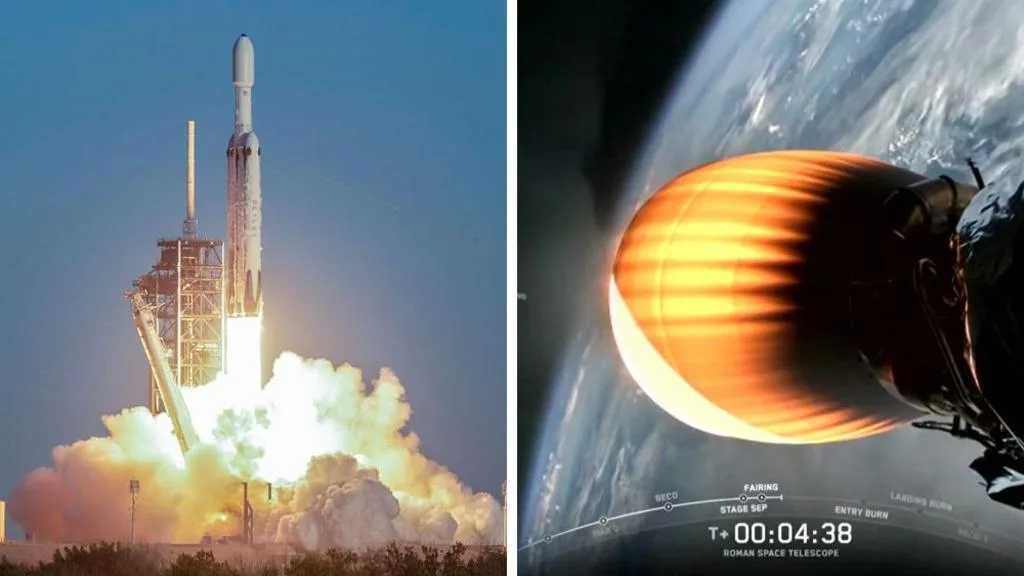
Roman mission begins after Florida launch
The Nancy Grace Roman Space Telescope was sent into space aboard a SpaceX rocket from Kennedy Space Center on Sunday morning local time. NASA's next-generation observatory was built to gather data on dark energy, black holes and other cosmic unknowns that shape the expansion of the universe.
About 30 minutes after launch, the spacecraft separated from the rocket and continued on its way to its operating location, about 1 million miles from Earth. NASA said the journey is expected to take about 100 days, after which the telescope will begin regular observations once it reaches its target point.
Nicky Fox said at a post-launch news conference that "Roman will change the way we see the universe." U.S. President Donald Trump also joined the event by phone and congratulated the scientists working on the project.
What questions will the mission try to answer?
Dark energy, dark matter and new worlds
One of Roman's main goals is to collect more detailed data on dark energy and dark matter, which are thought to make up much of the universe but whose nature remains unclear. According to NASA, the two together account for about 95% of the universe; one appears to drive the acceleration of expansion, while the other acts like an invisible gravitational glue.
- Finding and characterizing planets outside the Solar System, known as exoplanets
- Mapping the distribution of billions of galaxies to study the universe's structure over time
- Scanning black holes and objects stretching from our Solar System to the edge of the observable universe
Fox said Roman could discover tens of thousands, even 100,000 new exoplanets. Scientists hope the observations will offer clearer insights into the atmospheres of distant worlds and help assess whether they could support life.
What sets Roman apart from other space telescopes?
A wide field of view and a distant operating post
NASA says Roman's field of view is 100 times wider than that of the Hubble and James Webb telescopes. That will allow astronomers to survey far larger swaths of sky and create broad cosmic maps, alongside observations focused on individual targets.
According to astronomer Jenifer Millard, the telescope's location at roughly four times the distance from Earth as the Moon's orbit is another major advantage. This means infrared light from Earth and the Moon will interfere less with the instruments' measurements.
Nancy Grace Roman, who gave the telescope its name, became NASA's first chief astronomer and first female senior manager in the 1960s. Roman helped secure congressional approval for the Hubble Space Telescope, and NASA is planning a five-year primary mission for the telescope, with the option to extend operations for up to 10 years.






Comments (0)
No comments yet. Be the first to comment.
Write a Comment