
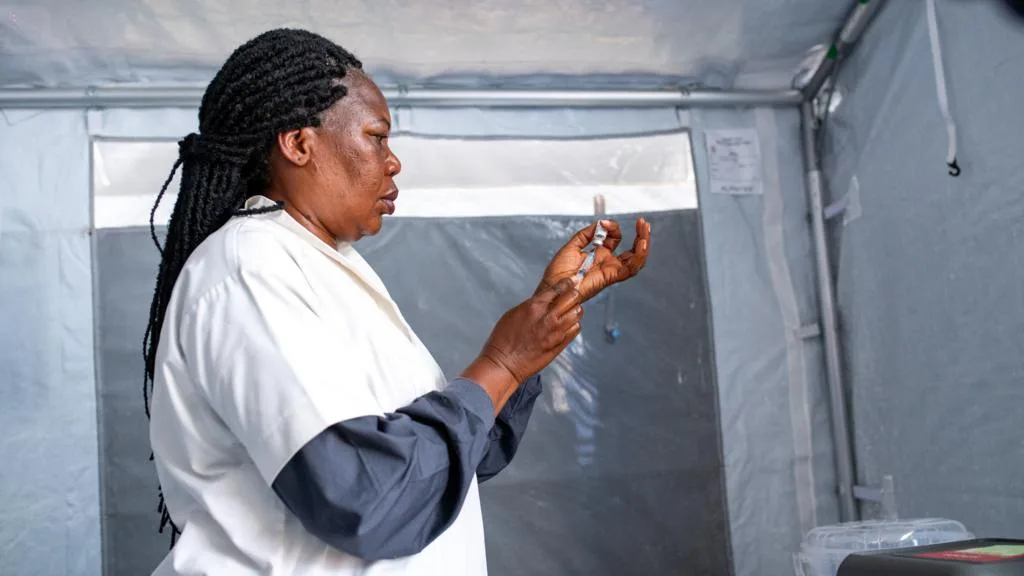
Kenya's first confirmed Ebola case ends in death
Kenya's first Ebola case was detected in a Kenyan citizen who had been living in the Democratic Republic of Congo for the past seven years. According to officials, the patient had been sick for about a month, received treatment at several hospitals in Congo, then traveled to Nairobi and died days after arriving in the capital.
Kenya's Health Minister Aden Duale said the patient entered the country by air on Saturday and underwent routine health screening at Nairobi's main airport. The patient was later taken by a relative to a hospital in the city and was then transferred to an isolation facility established during the Covid-19 pandemic.
According to the ministry, the patient showed fever, chills, severe weakness, difficulty swallowing, muscle pain and bleeding under the skin. Samples taken because of the travel history and symptoms confirmed that the patient had the rare Bundibugyo strain of the Ebola virus. The patient died at 11:30 p.m. on Monday and was buried on Tuesday in line with public health protocols.
Contact tracing and entry-point precautions expanded
The Kenya Ministry of Health said surveillance at airports and border crossings had been further increased after the case. Officials said the patient had traveled overland from the Democratic Republic of Congo to Kampala, the capital of Uganda, before flying to Nairobi.
- 28 contacts have been identified, including family members and health workers.
- Additional follow-up has begun for 23 passengers and 4 crew members on the same flight.
How did the patient pass airport screening?
A senior Health Ministry official said the patient's medication may have suppressed the symptoms. As a result, the infection may not have been detected on arrival even though the person cleared routine screening.
Duale told Kenyans there was “no need to panic.”
Why is the outbreak in the Democratic Republic of Congo causing concern?
According to World Health Organization (WHO) data, the current outbreak has so far recorded 8,544 cases and 4,114 deaths. That makes it the largest Ebola outbreak ever recorded in the Democratic Republic of Congo.
No approved vaccine or treatment for the Bundibugyo strain
The Bundibugyo strain behind the current outbreak is known as a relatively rare variant of Ebola. There is no approved vaccine or treatment for this strain, although four vaccines are under development and human trials for one of them began in July.
International aid groups say conflict in eastern Congo, displacement and weak health infrastructure are making case tracking and testing more difficult. That is increasing the risk of the virus spreading to new areas.



Comments (0)
No comments yet. Be the first to comment.
Write a Comment
Yorum yazmak için giriş yapın. Üyelik ücretsiz; yorumunuz editör onayından sonra yayımlanır.