
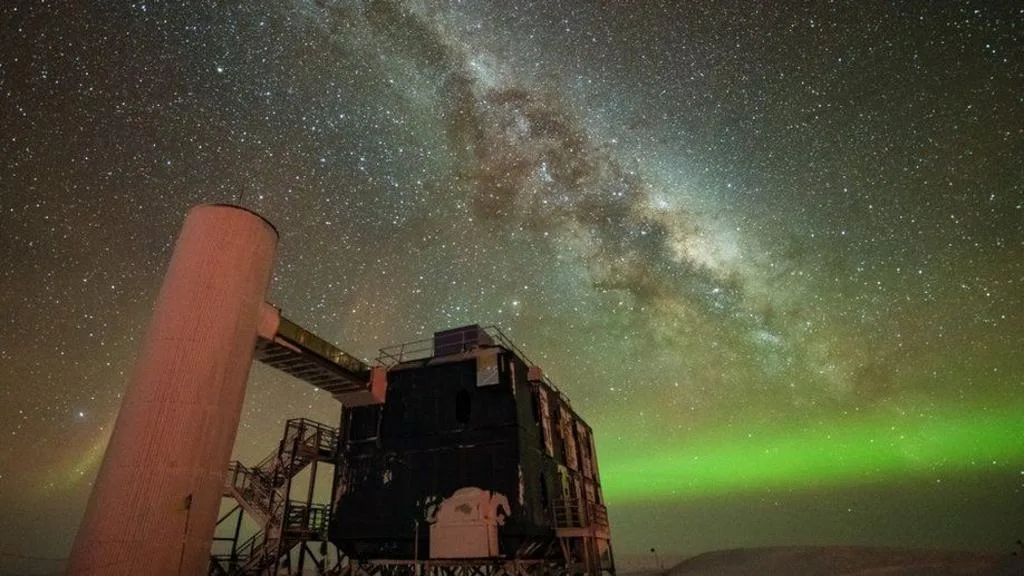
The IceCube project reaches the Nobel stage
The Nobel Prize in Physics has been awarded to Belgian-born physicist Francis Halzen, who led the development of the IceCube Neutrino Observatory in Antarctica. Halzen, who is now a U.S. citizen and works at the University of Wisconsin-Madison, is regarded as one of the central figures behind the project to track neutrinos that carry information from violent cosmic processes in the distant universe.
The Royal Swedish Academy of Sciences said Halzen's scientific vision and leadership were decisive in establishing the observatory. Halzen said he first came up with the idea of detecting neutrinos at the South Pole in 1988, and that the project has delivered better-than-expected results.
How does the observatory work?
IceCube consists of thousands of light sensors placed within a volume of about 1 cubic kilometer in the Antarctic ice sheet. The Sun also produces large numbers of neutrinos, but this facility is specifically searching for high-energy neutrinos created by violent events beyond the Solar System.
Most neutrinos pass through the ice without leaving a trace. In rare cases, when a neutrino interacts with an atomic nucleus, it creates fast charged particles that leave a blue glow in the ice; detectors then use the timing and pattern of that light to calculate which direction the signal came from.
Why are neutrinos critical for science?
Neutrinos are seen as messenger particles that can carry direct information from events in the distant universe. That is because they pass through matter largely unhindered and, since they have no electric charge, their path is not bent by magnetic fields in space.
- They can pass through dense gas and dust, carrying information from places where light has difficulty getting through.
- Because their direction of travel is preserved, they can show researchers where the source is located in the universe.
These properties allow scientists to study regions that cannot be easily observed with ordinary telescopes. The data collected is used to examine how the environments around exploding stars and giant black holes accelerate particles to extraordinary energies.
The scientific community's view
Nobel Physics Committee Chair Mark Pearce said Halzen led an international team of researchers and engineers and helped open the door to a new observational tool. Louis Barson, science director at the Institute of Physics in London, also said IceCube makes it possible to study cosmic events that traditional telescopes cannot see.
Halzen, meanwhile, pointed to the skepticism surrounding the project in its early years, saying at a news conference: “Maybe it was a good idea, but very few people thought it would work.”
"""





Comments (0)
No comments yet. Be the first to comment.
Write a Comment
Yorum yazmak için giriş yapın. Üyelik ücretsiz; yorumunuz editör onayından sonra yayımlanır.