
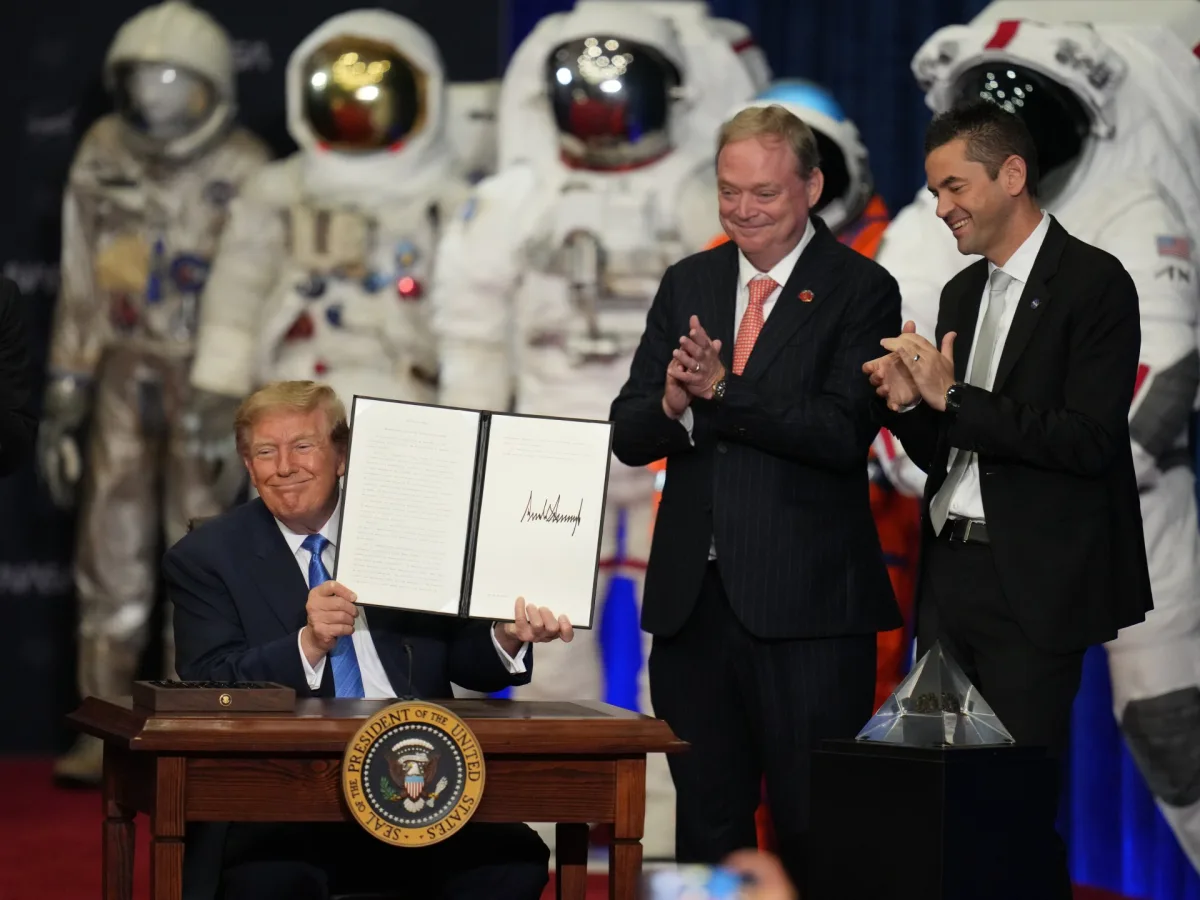
Order announced at NASA event in Texas
U.S. President Donald Trump signed an executive order establishing the country’s first U.S. Space Academy. The announcement was made on Friday at NASA’s Johnson Space Center in Texas during a ceremony for the four-member Artemis II crew.
Trump compared the new institution to elite national academies such as the U.S. Naval Academy and West Point. The order also calls for the creation of a new commission to advise the president and support the academy’s establishment process.
Commission to guide the founding process
NASA Administrator Jared Isaacman will lead the commission. The body will also include senior officials such as Defense Secretary Pete Hegseth, Air Force Secretary Troy Meink and White House Office of Management and Budget Director Russ Vought.
- The commission’s job will be to advise the president on establishing the academy.
- During the planning stage, the training model is expected to be shaped around the needs of public institutions and the civilian aviation sector.
Where will graduates serve?
According to Trump, graduates of the academy are expected to serve in the Space Force, NASA and the civilian aviation industry. Space policy has remained one of the Trump White House’s priorities in both of his terms.
In 2019, Trump signed legislation creating the Space Force, the sixth branch of the U.S. military. The new academy initiative is seen as a continuation of that approach, which treats national security and space capability within the same framework.
Artemis ceremony and questions over the program
At the ceremony, Trump awarded the Congressional Space Medal of Honor to the four members of the Artemis II crew. The award is described as the highest civilian honor in the U.S. for achievements in spaceflight.
The recipients were NASA astronauts Reid Wiseman, Victor Glover and Christina Koch, along with Canadian astronaut Jeremy Hansen. In April, the crew completed one of the farthest human spaceflight missions to date by looping around the far side of the Moon.
The mission stood out as an important milestone in the Trump administration’s plan to return astronauts to the Moon by 2028. However, uncertainty remains over the next phases of the Artemis program.
In May, an uncrewed Blue Origin rocket exploded at a launch facility in Cape Canaveral, Florida, raising questions about the readiness of upcoming missions. In February, NASA also announced it was dropping the goal of a Moon landing for Artemis III and instead focusing the mission on Earth-orbit safety and docking exercises; in June, it announced a new crew for the two-week Artemis III mission planned for next year.
"""




Comments (0)
No comments yet. Be the first to comment.
Write a Comment
Yorum yazmak için giriş yapın. Üyelik ücretsiz; yorumunuz editör onayından sonra yayımlanır.