
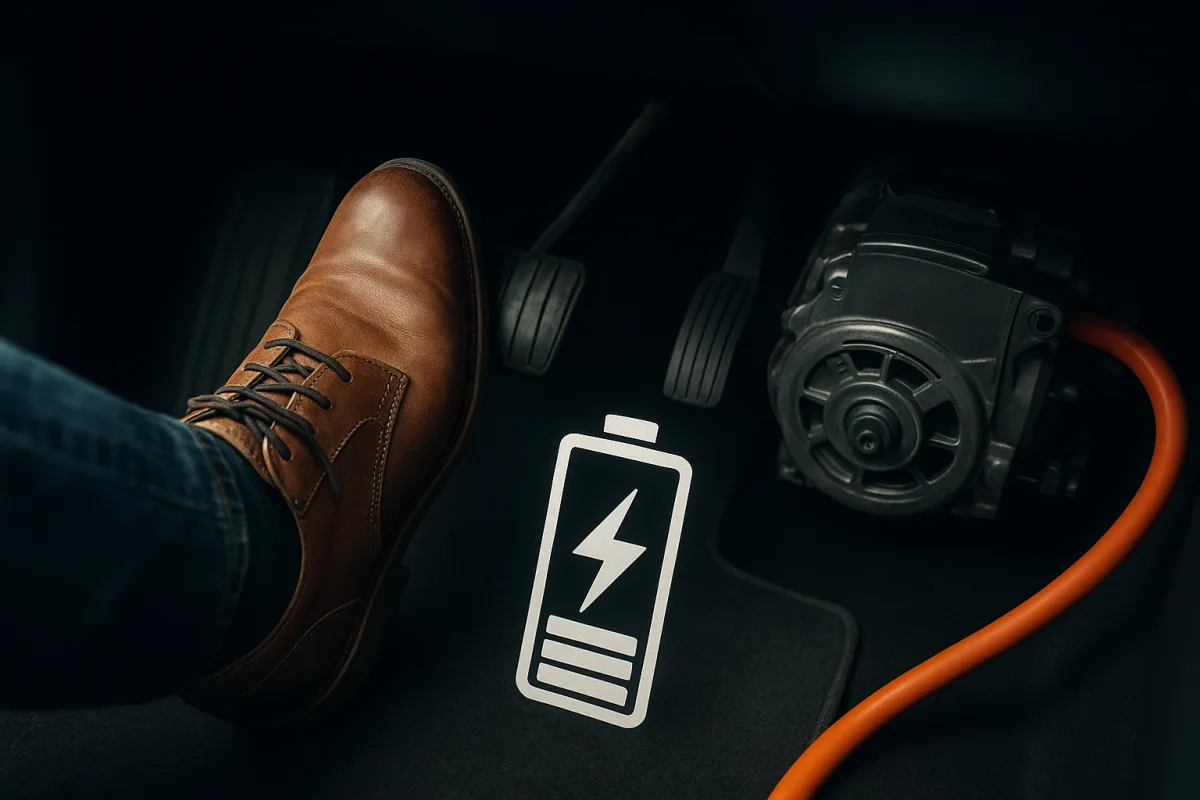
What is regenerative braking and how does it work?
Regenerative braking operates on the principle of converting a portion of the kinetic energy generated as an electric vehicle slows down back into stored electrical power. While conventional braking dissipates this energy as lost heat, the traction motor in an EV operates in reverse to capture and reuse it.
In daily operation, when the driver lifts off the accelerator or lightly presses the brake pedal, the vehicle utilizes the electric motor before engaging mechanical brakes. This decelerates the car while recharging the battery under favorable conditions. However, energy recovery depends on factors such as vehicle speed, road incline, traffic conditions, battery temperature, and charge status.
Why does the motor act as a generator?
Electric motors are inherently bidirectional. The same motor that propels the vehicle forward can act as a generator when driven by the momentum of the spinning wheels. This concept is the foundation of regenerative braking: capturing energy that would otherwise be wasted during deceleration and feeding it back into the battery.
How does it impact driving range and energy efficiency?
Energy recovery is especially effective in stop-and-go city driving, where frequent slowing and downhill stretches provide repeated opportunities to reclaim power. While it does not single-handedly double driving range, it plays a key supporting role in boosting total energy efficiency.
However, the system's effectiveness varies. On long highway stretches at steady speeds, recovery opportunities are minimal. Furthermore, if the battery is nearly full or if thermal management systems restrict input, the level of regeneration will automatically decrease.
- Its benefits are most noticeable in urban traffic with frequent stopping.
- It helps reduce wear and load on mechanical brakes during long downhill descents.
- Energy recovery may be restricted if battery conditions are not optimal.
How does it alter driving feel, and what should drivers know?
Regenerative braking noticeably alters how an electric vehicle handles. The moment a driver lifts off the accelerator, the vehicle decelerates much more firmly than a conventional internal combustion vehicle. Because of this, many drivers adapt quickly to a "one-pedal driving" experience, while others may prefer selecting lower regeneration settings.
In most EV models, regeneration strength can be adjusted via drive modes or paddle shifters. Higher settings offer smoother control in heavy traffic and on descents while reducing brake pedal use. Nevertheless, mechanical brakes remain the primary line of safety in emergency stopping scenarios; regenerative braking complements traditional braking rather than replacing it.
Ultimately, regenerative braking is not merely a feature designed to extend range. It is a core electric vehicle technology that optimizes energy consumption, enhances brake system durability, and reshapes the overall driving dynamic.

Comments (0)
No comments yet. Be the first to comment.
Write a Comment
Yorum yazmak için giriş yapın. Üyelik ücretsiz; yorumunuz editör onayından sonra yayımlanır.