
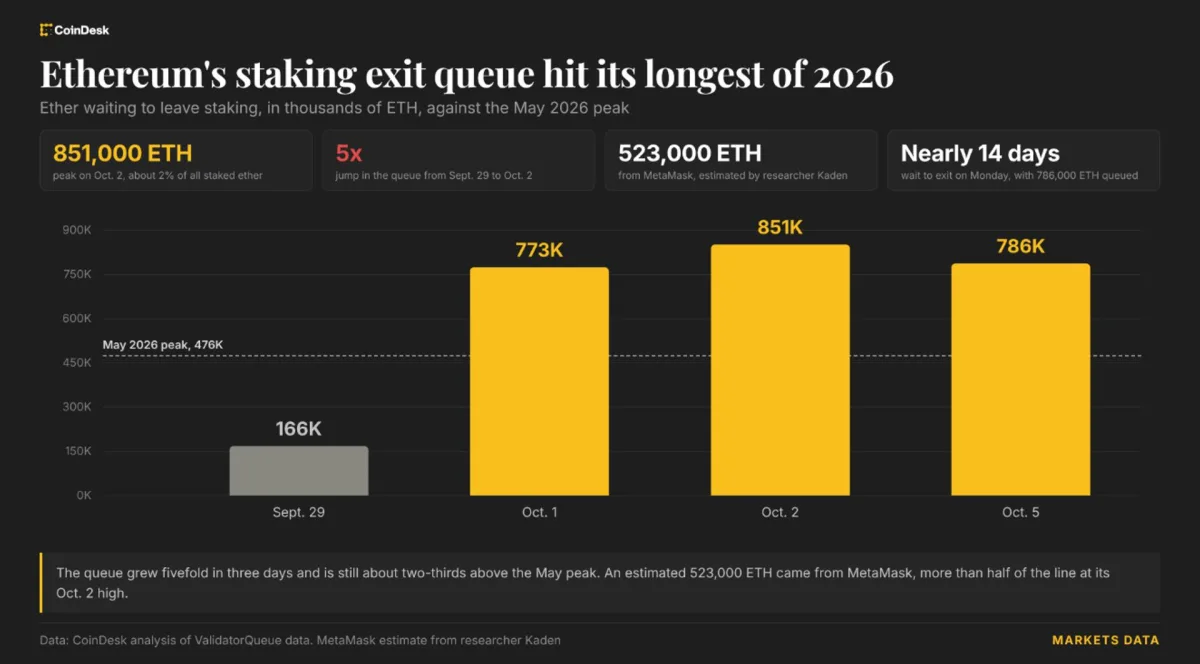
Why did the Ethereum staking queue get longer?
The Ethereum staking queue has become more noticeable in recent days because of the network’s daily processing limits. Under current rules, about 57,600 ETH can enter the network each day, and the same amount can exit. That cap can cause large one-time moves to pile up in the queue.
Assets that enter the exit queue do not reach wallets immediately after leaving the validator process. ETH must also pass through a separate withdrawal stage before it returns to the investor’s wallet. That adds to the total waiting time, especially during busy periods.
MetaMask and Lido are at the center of the withdrawal spike
According to the source text, most of the recent jump in withdrawals came from MetaMask. In addition to its crypto wallet service, the company also runs validators for Lido, which pools users’ ether for staking.
Preventive exits followed a security incident
On September 30, MetaMask disclosed a security incident and began taking the affected validators out of service. In its October 1 update, the company said it had found no evidence that wallets or customer funds were affected in the investigation.
According to Ethereum security researcher Kaden’s estimate, these preventive exits cover about 17,000 validators and 523,000 ETH. However, those figures have not been confirmed by MetaMask.
- Daily staking entry capacity: 57,600 ETH
- Daily staking exit capacity: 57,600 ETH
- Estimated affected validators: 17,000
- Estimated affected assets: 523,000 ETH
What does this mean for the market, and what should stETH holders expect?
The picture suggests that a significant part of the exit queue is a temporary distortion tied to the assets of a single operator. Lido expects assets to return gradually as the affected validators leave the system, balances are withdrawn and ETH re-enters the staking process.
According to the protocol, the full process could take up to 45 days. During that time, the validators taken out of service will not earn rewards. Last week, Lido said in a
"stETH holders do not need to take any action"message.
From a market perspective, the development points less to a direct loss of funds than to operational delays and the risk of temporary yield loss. Even so, the longer queues once again show how quickly technical or security-related problems at large staking operators can affect the network’s liquidity flow.
"""





Comments (0)
No comments yet. Be the first to comment.
Write a Comment
Yorum yazmak için giriş yapın. Üyelik ücretsiz; yorumunuz editör onayından sonra yayımlanır.